
Loading...
Serving Little Rock, AR and surrounding areas. (501) 621-2141
Little Rock clay soil moves every season - and it takes your foundation with it. We diagnose exactly what is happening and fix it permanently, so sticking doors, cracked walls, and sloping floors are not something you deal with again.
Foundation repair in Little Rock addresses the damage caused by expansive clay soil that swells and shrinks with every wet season and dry spell - most jobs take one to three days and restore doors, windows, and floors to their original position. The goal is to stop the movement completely, not just patch the cracks on the surface.
Little Rock homeowners in neighborhoods like Hillcrest and the Heights deal with this more than most. Homes built before 1970 often have shallower footings that were never designed for decades of clay movement. If you are also seeing crumbling mortar on your chimney or exterior brickwork, that is often related - our chimney repair team handles that side of things, and we also do foundation block wall installation for full structural replacement.
The most important step is a proper on-site assessment - not a phone estimate. The repair method that makes sense depends entirely on how much movement has occurred and where the stable soil layer sits beneath your property.
These signs often appear gradually. Seeing more than one at the same time is a signal worth acting on.
If interior doors that used to swing freely now drag on the floor or refuse to latch, your home may be shifting. This is one of the most common early signs Little Rock homeowners notice after a dry summer when clay soil contracts. If it is happening in multiple rooms or getting worse each year, have someone look at the foundation.
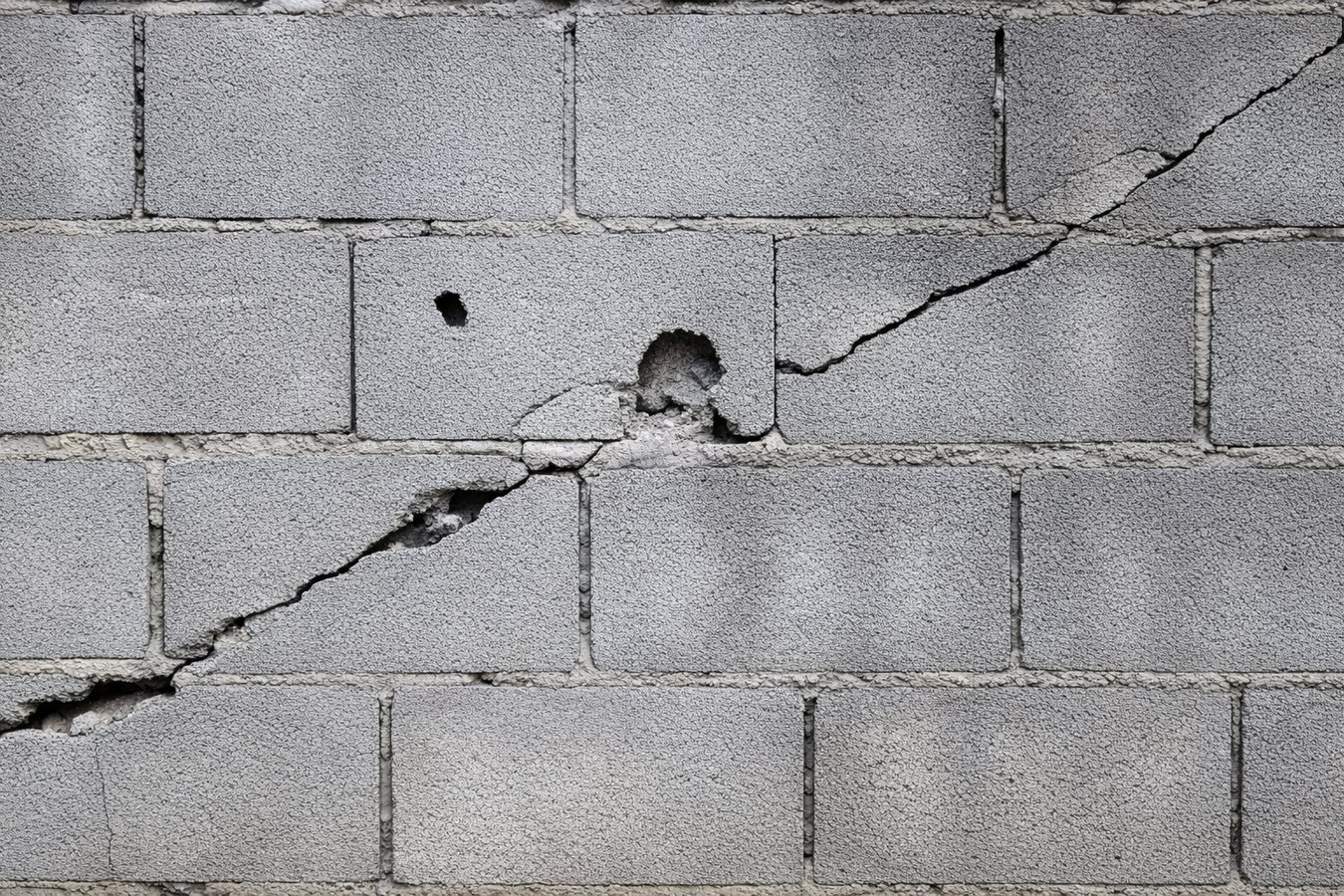
Cracks that follow a stair-step pattern along mortar joints - rather than running straight through the brick - are a reliable sign that one section of your foundation has moved relative to another. This pattern is common in older brick homes in neighborhoods like Hillcrest and the Heights where decades of clay movement have accumulated.
These diagonal lines follow the path of stress when a foundation shifts and tend to widen over time if the underlying movement is not stopped. They are different from the small settling cracks most homes develop. If you are seeing this in more than one room, it is worth taking seriously.
Place a marble on your floor and watch what happens. If it rolls consistently toward one wall, or if you feel a noticeable slope when walking from room to room, your slab or floor joists may have settled unevenly. In older Little Rock homes on pier-and-beam foundations, this often means the wooden supports beneath the floor have shifted or deteriorated.
We use steel pier systems for homes that have experienced significant settling - piers are driven deep into stable soil below the clay layer and are designed to be a permanent fix, not a patch. For slab homes that have lifted or sunk in isolated spots, we use slab injection to fill voids beneath the concrete and restore levelness without full excavation. These two methods cover the majority of foundation issues we see in Little Rock, and we pair each with the drainage assessment your contractor should have completed as part of a thorough repair plan.
For homes where the issue is not settling but wall deterioration, we also offer foundation block wall installation. And if your exterior masonry or chimney also needs attention after years of the same soil movement, we handle that in the same visit when possible.
Best for homes with significant, ongoing settling. Piers reach bedrock and are designed to hold permanently.
Ideal for isolated low spots under concrete slabs. Fills voids and lifts the slab back without full excavation.
For homes where block walls have cracked or bowed. We rebuild or reinforce the wall from the ground up.
Little Rock sits on a belt of highly expansive clay soil that swells when it gets wet and shrinks in dry heat. Every summer, the clay pulls away from foundations. Every wet winter, it pushes back from a new angle. This cycle is the single biggest reason foundations shift and crack here, and it is why repairs that hold up in a drier climate sometimes fail faster in central Arkansas. Parts of the city near the Arkansas River also sit in areas with higher groundwater, which accelerates the movement further. We work across North Little Rock and Benton as well, where the same clay conditions apply.
Many of Little Rock's most established neighborhoods - Hillcrest, the Heights, Pulaski Heights - have homes built between the 1920s and 1960s on footings that were not designed for this kind of long-term soil behavior. If your home is over 40 years old and the foundation has never been assessed, it is worth scheduling a walkthrough before visible problems appear. The University of Arkansas Cooperative Extension has published guidance on managing expansive soil around residential foundations in this region, available at uaex.uada.edu.
We respond within 1 business day. You describe what you have noticed - sticking doors, cracks, sloping floors - and we schedule a free on-site visit. No technical knowledge required.
We walk the perimeter, check interior symptoms, and take measurements to determine how much the foundation has moved. You receive a written, itemized estimate within a few days - no surprises.
Once you approve the contract, we pull the required City of Little Rock building permit before any work begins. This typically adds a few business days but ensures the work is city-inspected.
Most jobs take one to three days. After completion, the city inspector visits to verify the work. We then walk you through before-and-after measurements and review your warranty documentation.
We respond within 1 business day. There is no obligation to move forward after the estimate. After you submit, someone from our office will call to schedule a free on-site assessment at a time that works for you.
(501) 621-2141We carry the contractor licensing and liability insurance required by the state of Arkansas. That protects you from financial exposure if anything unexpected happens on your property during the repair.
Every estimate requires us to see your home in person. Phone quotes for foundation work are not reliable - the cost depends on how many piers are needed and how deep stable soil sits. You will never be pressured after the estimate.
We pull the required permits for every structural job in Little Rock. That means the work is reviewed by a city inspector, not just our crew. It also creates a paper record that works in your favor when you sell the home.
We know the seasonal movement patterns in neighborhoods like Hillcrest, Broadmoor, and West Little Rock. That local knowledge shapes how we design repairs - not just what depth to drive piers, but how to account for drainage and waterproofing so the same problem does not come back.
These are not just credentials on paper - they directly affect your experience and your protection. A permitted job with documented measurements and a transferable warranty is a fundamentally different product than an unpermitted patch. For more on choosing a foundation repair contractor, the Foundation Repair Association publishes consumer guidance on what to look for and what to avoid.
Foundation movement often cracks chimney mortar and shifts flue liners - we repair both so the structural fix is complete.
Learn moreWhen block foundation walls have cracked or failed beyond repair, we install new block wall systems built to last.
Learn moreLittle Rock clay soil will not stop moving - but your home does not have to move with it. Call now or submit a request and we will be in touch within 1 business day.